
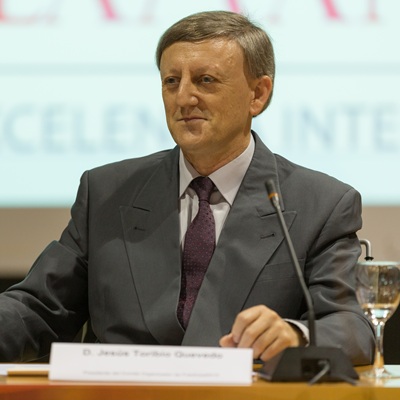
Biography
Professor Jesús Toribio graduated in Civil Engineering in 1982 and then in Mathematics in 1986. In 1987 he
was awarded his PhD in the Polytechnic University of Madrid (UPM) and turned into Associate Professor in
that Institution. In 1992 he became Full Professor and Head of the Materials Science Department of the
University of La Coruña (at the age of 32, thus being the youngest Full Professor in the area of Materials
Science in Spain). In 2000 he moved to the University of Salamanca (USAL) where is currently Full
Professor of Materials Science & Engineering and Head of the Fracture & Structural Integrity Research
Group (FSIRG) of that Institution.
His research work is mainly concerned with fatigue and fracture mechanics, environmentally assisted
cracking, stress corrosion cracking and hydrogen embrittlement/degradation/damage of metals and alloys
(mainly cold drawn pearlitic steel wires for civil engineering and austenitic stainless steels for nuclear
engineering and energy applications), covering theoretical, computational and experimental aspects. He
actively participates in International Scientific Conferences, very often being a member of the International
Advisory Committee, organising Special Sessions and Symposia, being Session Chairman or specially
delivering Plenary/Keynote/Invited Lectures. Professor Dr. Jesús Toribio has published more than 600
scientific papers, most of them in international books and journals.
He is the Chairman of the Technical Committee 10 (TC10): Environmentally Assisted Cracking & Hydrogen
Embrittlement of the European Structural Integrity Society (ESIS) and has been Director (2013-2017) of the
International Congress of Fracture-The World Academy of Structural Integrity (ICF-WASI), being responsible
of launching the Ibero-American Academy of Structural Integrity (IA2SI). Prof. Toribio has been awarded a
variety of scientific research prizes and awards including: (i) UPM Young Scientist Award of the Polytechnic
University of Madrid; (ii) METROTEC Award for the best Technological Research Project; (iii) Honour Medal
of the Spanish Group of Fracture (GEF/SEIE) in recognition of his research achievements in the field of
fracture mechanics; (iv) Fellow of the Wessex Institute of Technology (WIT) in recognition of leadership and
outstanding work in engineering sciences; (v) Top Reviewer 2011 in recognition of an outstanding
contribution to the quality of the Elsevier International Journal Engineering Fracture Mechanics; (vi) Fellow of
the European Structural Society (ESIS Fellow) for his outstanding contributions to the art, science, teaching
or practice of fracture mechanics and his service to the society; (vii) Honorary Member of the Italian Group of
Fracture (IGF) in acknowledgement and appreciation of his outstanding achievements in the research field
of fracture mechanics; (viii) Best Paper and Presentation Award in the International Conference on Energy
Materials and Applications (ICEMA 2017) held in 2017 in Hiroshima, Japan, with a paper entitled: Numerical
Simulation of Hydrogen Diffusion in the Pressure Vessel Wall of a WWER-440 Reactor; (ix) María de
Maeztu Scientific Award of the University of Salamanca (800th anniversary during 2018) in recognition of
academic trajectory and excellence in scientific and technological research; (x) Scientific Merit Award of the
Portuguese Group of Fracture (PGF) in recognition of scientific contributions during his career.